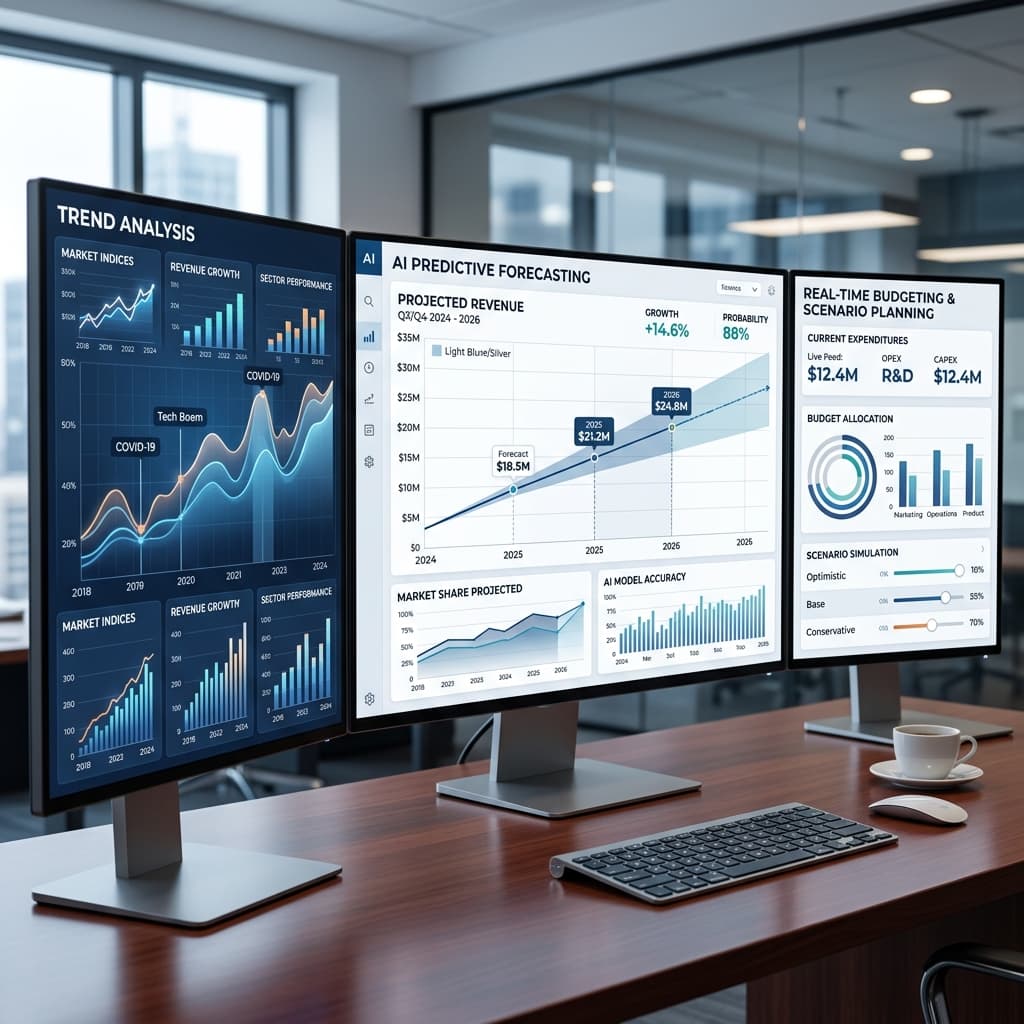
Financial forecasting has traditionally been a grueling exercise of gathering historical data, applying a few "Growth %" assumptions in a spreadsheet, and hoping for the best. But in a world of supply chain shocks, inflationary spikes, and rapid market pivots, Static Forecasting is a Liability. AI introduces the era of Dynamic Intelligence—forecasting that lives and breathes in real-time, adjusting its predictions as every invoice, sales order, and market event occurs.
The "Signals vs. Noise" Problem
Traditional forecasting often misses the nuance because it only looks at a few variables. An AI-driven model can ingest Thousands of Financial Signals simultaneously: internal spend rates, employee headcount trends, raw material price fluctuations, and even external macroeconomic indicators. The agent uses its "Reasoning Layer" to filter out the noise and identify the signals that actually correlate with your future cash position. This leads to a level of accuracy that 2-month-old spreadsheet models can never match.
Simulating the "What If" Scenarios
CFOs are constantly asked: "What if we accelerate this project by 3 months?" or "What if our primary shipping costs rise by 12%?" Answering these manually takes days of re-working models. With AI, these Scenario Simulations happen in seconds. You can "ask" your financial agent to model the 90-day impact of an interest rate hike on your working capital, or the ROI of 10X-ing your marketing spend in a specific region. This "Real-Time Sensitivity Analysis" empowers the executive team to make bold decisions with clear visibility into the trade-offs.
Autonomous Variance Analysis
Identifying a "Variance" (budget vs. actual) is easy; identifying the Cause is hard. Typically, a finance manager spends days investigating why a department went over budget. An AI financial agent can perform Autonomous Root-Cause Analysis. It scans every transaction in the "Over-Budget" bucket and tells you exactly what happened: "A one-time emergency hardware purchase from an off-catalog vendor caused a 14% spike in IT OpEx." This speed of insight allows for immediate course-correction before the "Small Variance" becomes a "Large Crisis."
Toward Continuous Planning and Allocation
The ultimate destination of AI in Finance is the End of the Annual Budget Cycle. Instead of a massive, 3-month "Budgeting Season" that is out-of-date by February, AI enables Continuous Allocation. Capital is deployed dynamically to the projects and departments that are delivering the highest "Predicted ROI." At Wheelson BizAI, we build the forecasting agents that allow your Finance team to stop being "Historical Accountants" and start being "Future Value Architects" who steer the company toward profitable growth with unmatched precision.