The ChallengeInsurance claim processing is one of the most complex, fraud-prone, and compliance-critical workflows in enterprise operations. Manual assessment is slow, inconsistent, expensive, and vulnerable to both human error and sophisticated fraud. Processing backlogs delay legitimate claimants and destroy customer trust. Meanwhile, the pressure to detect fraud — including organized SIU-level fraud — is mounting while teams lack the analytical bandwidth to investigate every claim thoroughly.
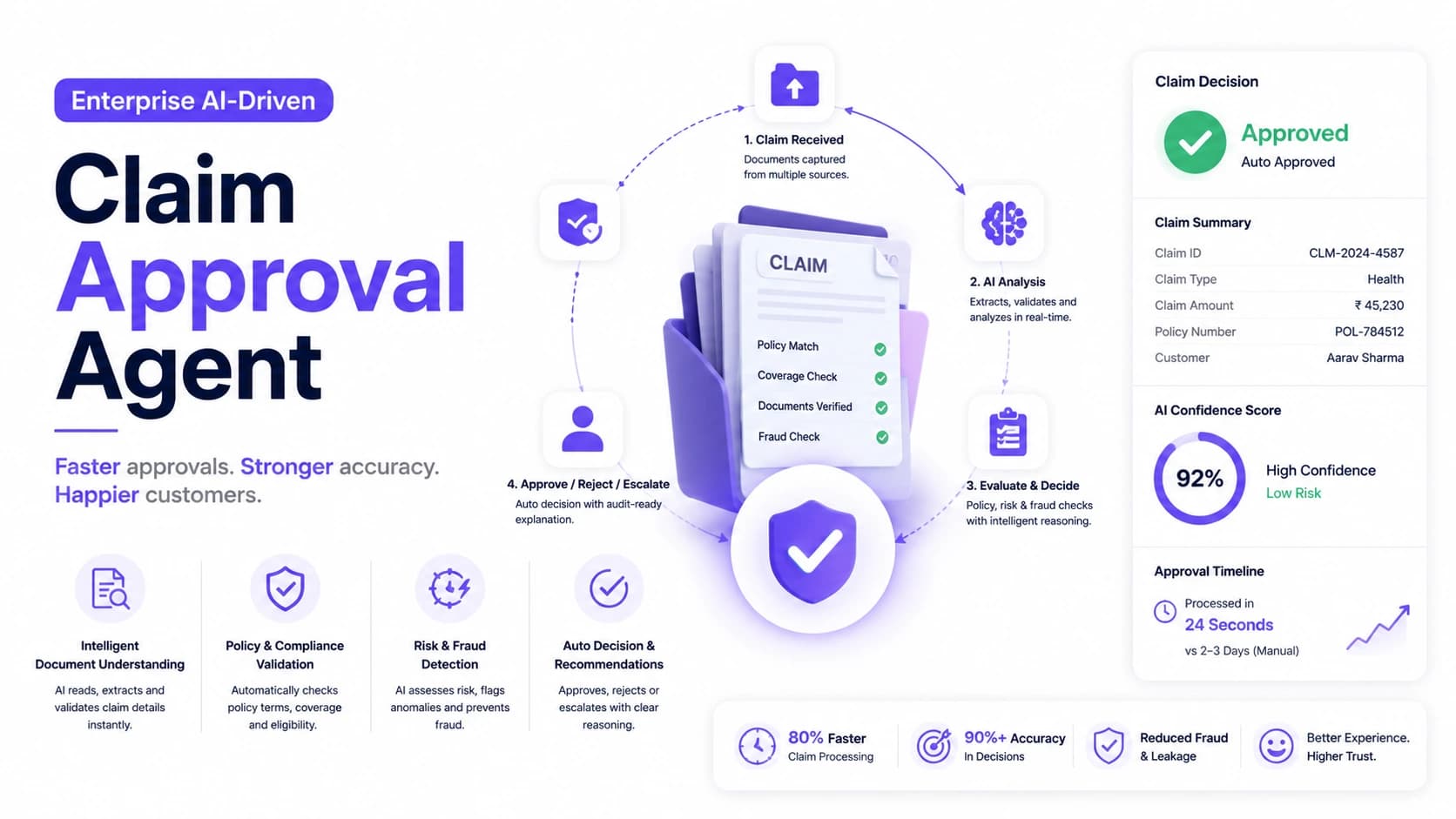
Our SolutionWe architected a comprehensive AI Claim Approval Agent implementing a 6-stage intelligent pipeline — from secure multi-channel intake to autonomous decision routing — combining Vision AI, damage detection models, fraud scoring, and an explainable decision engine, with a hardened human-in-the-loop fallback for edge cases.
The Claim Processing Crisis
Insurance claim processing sits at the intersection of two opposing pressures: the need to pay legitimate claims quickly to maintain customer trust, and the imperative to rigorously investigate potentially fraudulent claims to protect the business. Manual processes struggle to balance both — slow thorough review or fast superficial assessment — and consistently fail at one or both.
The scale of the problem is massive. A mid-size insurer might process thousands of claims daily across auto, property, and liability lines. Each claim involves multiple documents, visual evidence, and policy verification. The cost of getting decisions wrong — either direction — is enormous.
The 6-Stage AI Architecture
We designed a resilient, sequential pipeline where each stage builds on verified outputs from the prior stage — ensuring no claim advances without complete, quality-checked data.
Stage 1: Secure Multi-Channel Intake
Claims arrive via email attachments, web portal uploads, and direct API submissions from partner systems. A unified intake layer normalizes all inputs into a standardized claim object, validates completeness, and issues an acknowledgment with a unique idempotency token — ensuring no claim is ever processed twice.
Stage 2: Enterprise Hygiene
Every document undergoes automated malware scanning before any AI model touches it. Additionally, EXIF metadata is stripped from all images — preventing location data, device information, and timestamp manipulation that sophisticated fraudsters might exploit.
Stage 3: Parallel AI Assessment
Three AI models run concurrently:
▸Vision OCR extracts all text data from claim forms, police reports, medical records, and supporting documents
▸Damage Detection analyzes photographic evidence to identify damage type, severity, and consistency with the described incident
▸Document Authenticity Analysis flags signs of tampering, manipulation, or inconsistency across documents
Stage 4: Severity Scoring & Risk Profiling
A multi-factor scoring engine aggregates all Stage 3 outputs to produce a severity score and fraud risk profile for each claim. This model is trained on historical claim data and continuously updated to recognize emerging fraud patterns.
Stage 5: Explainable Decision Engine
The AI decision engine produces a routing recommendation — Proceed (auto-approve), Inspect (adjuster review), or SIU Fraud (Special Investigations Unit referral) — along with a plain-language explanation of every factor that influenced the decision. This explainability is critical for regulatory compliance and for building adjuster trust in AI recommendations.
Stage 6: Audit & Reporting
Every stage output, every score, every decision, and every human intervention is written to an immutable audit log. Automated reports are generated for management review, regulatory submissions, and continuous AI performance monitoring.
The Outcome: Speed with Integrity
The system processes claims in a fraction of the time of manual review while dramatically improving consistency and fraud detection rates. Legitimate claimants receive faster decisions. High-risk claims receive more thorough scrutiny. And every decision — whether made by the AI or a human adjuster — is fully documented and defended.